Collagen is the most abundant protein in the human body and the structural foundation of connective tissue. Its triple helix draws stability from repeating Xaa-Yaa-Gly sequences rich in proline and 4-hydroxyproline, and that hydroxyproline is itself a post-translational modification. The enzyme collagen prolyl-4-hydroxylase installs a hydroxyl group that forces the proline ring into a Cγ-exo pucker, constraining the backbone torsion angle φ to near −60° and preorganizing the chain for folding. The modification stabilizes the helix and is essential for animal life. The cell has no way to undo it.
Researchers in the Raines Group at Massachusetts Institute of Technology, published in the Journal of the American Chemical Society, asked whether a reversible modification could do the same structural work. The team synthesized nine host-guest collagen-mimetic peptides with the sequence Ac-(POG)3XYG(POG)2(PO)-NH2, replacing the central Xaa or Yaa residue with serine, threonine, or the O-phosphorylated form of each. Circular dichroism spectroscopy confirmed that every peptide folded into a triple helix, and thermal denaturation monitored at 225 nm gave the melting temperature Tm at which each helix unfolds.
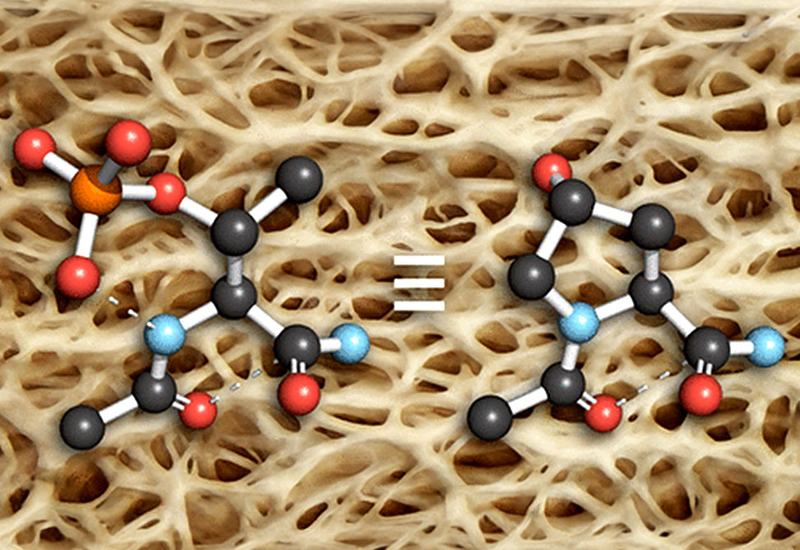
At the Yaa position, phosphothreonine raised Tm by 10.5 °C relative to unphosphorylated threonine, close to the stabilization that hydroxyproline itself provides, while phosphoserine at the same position lowered Tm by 2.1 °C. A single methyl group accounts for the split. Threonine carries a 3R-methyl group that serine lacks, and that group locks the phosphorylated side chain into a compact, hydrogen-bonded ring that holds φ near −60°, the geometry hydroxyproline enforces at Yaa. At the Xaa position, where the favored torsion angle sits near −75°, phosphothreonine and phosphoserine raised Tm by 6.9 and 5.9 °C, similar gains that point to a nonspecific effect rather than shape-matching. The Yaa stabilization held even though the phosphorylated peptide carries three dianionic residues and the Coulombic repulsion they bring.
The team then tested reversibility directly. Calf intestinal phosphatase, a mammalian secretory enzyme, stripped the phosphoryl group from within the folded triple helix, and Tm fell back to that of the unmodified threonine peptide.
To weigh biological relevance, the researchers analyzed how serine and threonine distribute across the triple-helical domains of 30 mammalian collagen chains. Threonine is enriched at the Yaa position in abundant fibrillar collagens, the position where its phosphorylation would confer the most stability, while serine shows no such bias and nonfibrillar collagens such as types IV and VI show no enrichment. The pattern casts phosphothreonine as a candidate switch for collagen remodeling in the extracellular matrix.
Because cells secrete both kinases and phosphatases, a phosphothreonine could raise or lower local helix stability on demand, tuning how readily collagenases unwind and cleave the helix during development, repair, or disease. MMP-1 recognizes a motif beginning at Gly865 of the human α2(I) chain and locally unwinds the helix to reach the scissile bond, so phosphorylation of the nearby Thr860 could shift that susceptibility. Inflammation, ischemia, and cancer each raise extracellular ATP and could drive the kinase activity that sets this switch in vivo. Hydroxyproline was identified in 1902 and phosphorylated amino acids in 1906, and this work draws a line between the two. Where hydroxylation preorganizes collagen for good, phosphorylation does comparable structural work reversibly, pointing toward collagen-based biomaterials whose stability can be switched on and off.