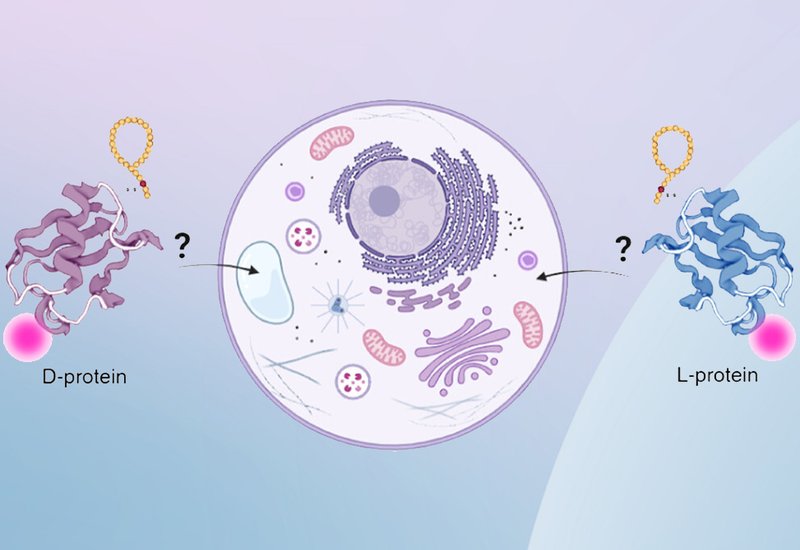
Mirror-image proteins built from D-amino acids offer compelling advantages as therapeutic candidates, including resistance to proteolytic degradation and reduced immunogenicity. Their synthesis by chemical means is well established, and discovery platforms such as mirror-image phage display have expanded the toolkit for finding D-peptide binders against biologically relevant targets. Yet one question has remained underexplored: when a D-configured cargo is conjugated to a cell-penetrating peptide, CPP, does its chirality influence how efficiently it enters cells? Because the plasma membrane is itself a profoundly homochiral environment, with L-amino acid proteins, D-sugar glycans, and stereospecifically configured phospholipid headgroups, there is a strong structural basis to expect that mirror-image cargos and their natural counterparts might interact differently with cellular uptake machinery.
Researchers in the Brik Lab at Technion-Israel Institute of Technology, published in the Journal of the American Chemical Society, synthesized three paired sets of enantiomeric cargos spanning a range of structural complexity: the intrinsically disordered SpyTag peptide, ST; the structured ~40-residue mini-protein FW1 conjugated to ST; and the globular 76-residue ubiquitin protein, Ub. Each cargo was prepared in both L- and D-configurations by SPPS and conjugated to an identical cyclic deca-arginine CPP, cR10, modified with 4-(dimethylaminoazo)benzene-4-carboxylic acid (DABCYL) via a reducible disulfide bond. All six constructs were labeled at the N-terminus with 5-carboxytetramethylrhodamine (TAMRA). Keeping the CPP scaffold and fluorophore constant across all constructs ensured that cargo chirality was the sole experimental variable. Uptake was quantified by flow cytometry, laser scanning confocal microscopy, and SDS-PAGE fluorescence analysis across HeLa, U2OS, and heparan sulfate-deficient Jurkat cell lines.
Across all three cargo systems and all concentrations tested (0.5, 1, and 2 μM), L-configured cargos showed consistently higher intracellular fluorescence than their D-counterparts. In HeLa cells, the L/D fold differences were approximately 3, 2.2, and 1.8 for ST, FW1-ST, and Ub, respectively; in U2OS cells, the corresponding values were approximately 4, 3, and 2.1. The decreasing fold difference with increasing cargo size suggests that larger, more structured cargos may engage plasma membrane components through broader surface interactions that partially offset the chirality bias. SDS-PAGE analysis of cell lysates from HeLa, U2OS, and Jurkat cells treated with 5 μM L- or D-TAMRA-Ub-CPP confirmed these trends, with L-TAMRA-Ub accumulating approximately 3-fold more than its D-counterpart across all three lines. Confocal z-stack analysis corroborated a roughly 2-fold difference in uptake across all cargo systems.
Mechanistic experiments pinpointed the source of the chirality bias. Cooling cells to 4 °C reduced L-cargo uptake by more than 90% while producing a smaller decrease for D-cargos, and largely abolished the L-over-D preference, implicating energy-dependent endocytic pathways rather than passive membrane translocation. Inhibition of clathrin-mediated endocytosis with chlorpromazine reduced uptake of both stereoisomers but maintained the L/D ratio for ST and Ub systems, whereas L-TAMRA-FW1-ST-CPP showed a disproportionately large (~50%) reduction compared to ~13% for the D-form, indicating that clathrin-dependent routes contribute more to L-form uptake of this intermediate cargo. Treatment with the macropinocytosis inhibitor 5-(N-ethyl-N-isopropyl)amiloride, EIPA, strongly reduced both ST stereoisomers (~85% and ~79%, respectively) and abolished the L/D difference for the Ub system, pointing to macropinocytosis as a dominant route for larger cargos. Taken together, these results demonstrate that chirality does not dictate a single uptake mechanism; instead, stereochemistry biases how each cargo engages a network of partially overlapping endocytic pathways.
These findings establish cargo chirality as an independent determinant of CPP-mediated intracellular delivery and carry direct implications for the design of mirror-image protein therapeutics. D-amino acid scaffolds confer stability advantages, but the present data show they also face a measurable delivery disadvantage relative to L-counterparts when delivered by cR10. Preliminary experiments with a Penetratin-based system reproduced the L-over-D preference, suggesting the effect is not limited to cyclic deca-arginine. The authors identify several directions for follow-up work, including testing additional CPP scaffolds, examining mirror-image versions of intrinsically cell-permeable proteins, and applying real-time fluorogenic labeling to track stereospecific differences in trafficking. More broadly, the study provides a conceptual framework for understanding how the chirality of a synthetic protein cargo reshapes its behavior at the boundary between the synthetic and the cellular world.